
Do Not Judge a Whole Faith by One Individual: A Message of Harmony in the Light of the Qur’an and Hadith
- আপডেট টাইম : শুক্রবার, ৩ এপ্রিল, ২০২৬
One of the most persistent problems in human society is the tendency to generalize judging an entire religion, community, or nation based on the actions of a single individual or a small group. This mindset has fueled division, prejudice, and conflict throughout history.
Yet, such a perspective is not only unjust but also contradicts fundamental moral and religious teachings. Islam, in particular, provides clear guidance against this kind of collective blame and strongly promotes justice, compassion, and peaceful coexistence among all people.
The Qur’an establishes a foundational principle of justice: every individual is accountable for their own actions. Allah says:
“No bearer of burdens will bear the burden of another.” (Qur’an 6:164)
This verse makes it clear that responsibility is personal. If one person commits a wrongdoing, the blame cannot be transferred to others whether they belong to the same family, ethnicity, or religion. To hold an entire group responsible for the actions of one individual is a violation of this divine principle.
Similarly, the Qur’an advises believers to avoid mocking or belittling others:
“O you who believe! Let not one group ridicule another; perhaps they may be better than them.” (Qur’an 49:11)
This verse reminds us that human worth is not determined by labels or identities, but by character and righteousness.
Islam places a strong emphasis on justice even in situations involving disagreement or conflict. The Qur’an states:
“Do not let the hatred of a people prevent you from being just. Be just; that is closer to righteousness.” (Qur’an 5:8)
This powerful message teaches that even if there is tension or dislike between groups, justice must prevail. It discourages sweeping generalizations and calls for fairness in every judgment.
The life of Prophet Muhammad (peace be upon him) offers a profound example of interfaith harmony and respectful coexistence. After migrating to Madinah, he established a social contract known as the Constitution of Madinah, which recognized Muslims, Jews, and other communities as part of a single society with shared responsibilities and mutual rights.
He treated people of other faiths with dignity and protection. In a well-known hadith, the Prophet said:
“Whoever ظلمs (oppresses) a non-Muslim citizen, I will be his opponent on the Day of Judgment.” (Abu Dawud)
This statement highlights the seriousness of injustice against non-Muslims and reinforces Islam’s commitment to protecting all members of society.
Islam acknowledges the presence and value of other religious communities, particularly Jews and Christians, referred to in the Qur’an as “People of the Book.” Allah instructs:
“And do not argue with the People of the Book except in a way that is best.” (Qur’an 29:46)
This verse encourages respectful dialogue, not hostility. It promotes understanding and constructive engagement rather than conflict.
As for followers of other religions, including Hindus and others, Islam upholds the universal principle of freedom of belief:
“There is no compulsion in religion.” (Qur’an 2:256)
This ensures that faith must be a matter of personal conviction, not force or coercion.
In today’s world, it is common to see entire communities blamed for the actions of a few individuals. When a Muslim commits a crime, some may wrongly associate it with Islam as a whole. Similarly, when someone from another religion does wrong, their entire faith is sometimes unfairly criticized.
Such thinking is deeply flawed. Islam teaches that individuals must be judged based on their own actions not their identity. Good and bad exist in every community, and no religion should be reduced to the behaviour of a few.
In an increasingly interconnected world, peaceful coexistence is more important than ever. Misunderstanding and prejudice only lead to division and instability, while mutual respect and empathy build stronger, more unified societies.
We can promote harmony by:
- Avoiding stereotypes and generalizations
- Seeking accurate knowledge about other religions
- Rejecting hate speech and misinformation
- Emphasizing shared human values such as compassion, justice, and kindness
Blaming an entire religion or community for the actions of one individual is not only irrational but also unjust and contrary to the teachings of Islam. The Qur’an and Hadith consistently emphasize personal responsibility, fairness, and respect for others.
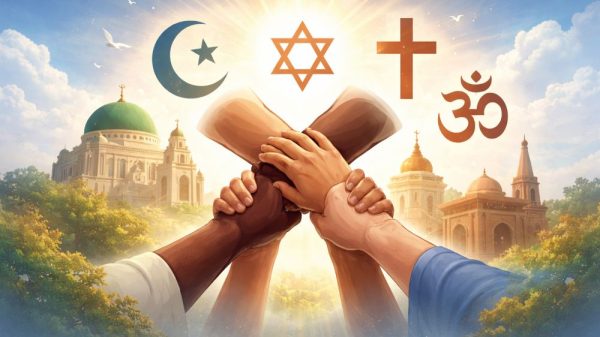
Muslims, Jews, Christians, Hindus, and people of all faiths are part of the diverse fabric of humanity. A peaceful society can only be built on the foundations of mutual respect, understanding, and justice.
Let us move beyond prejudice and embrace a path of harmony where we judge individuals fairly, treat others with dignity, and uphold the values that unite us all. This is the true message of Islam, and indeed, the true path of humanity.
Editor : Muhammad Zakir Hossain