
Bangladesh’s Human Rights Record Faces a Crucial Test in 2026
- আপডেট টাইম : বৃহস্পতিবার, ২৭ আগস্ট, ২০২৬
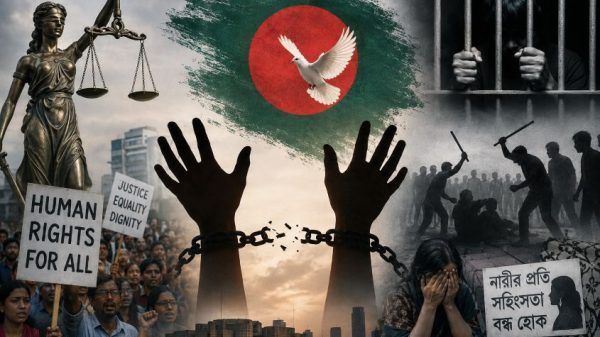
Bangladesh is going through an important period of political and social change in 2026. Following the political upheaval and mass movement of the previous year, people had high hopes for a new system based on justice, accountability, democracy and respect for human rights.
The government has taken several steps towards institutional reform. Different reform commissions have been formed, and there have been promises to strengthen the judiciary, improve law enforcement and protect basic rights. However, the situation on the ground remains mixed.
While there have been some positive changes, new concerns have also emerged. Mob violence, political cases, weak law enforcement, attacks on minorities, violence against women and problems faced by workers continue to raise questions about the country’s human rights situation.
This report looks at the major human rights concerns in Bangladesh during the first eight months of 2026.
One of the biggest concerns in 2026 has been the rise of mob justice. In several parts of the country, people accused of crimes have been attacked or beaten by groups of people before they could face a proper legal process.
The rule of law means that an accused person must be taken through the legal system and given the opportunity to defend himself or herself. When people take the law into their own hands, the basic principles of justice are seriously damaged.
Rumours, personal disputes and political tensions have sometimes played a role in such incidents. Social media has also been used to spread unverified information, which can quickly lead to public anger and violence.
The police and other law enforcement agencies have a major responsibility in preventing such incidents. At the same time, allegations of deaths in custody, torture and excessive use of force need proper and independent investigation.
Ensuring justice for past human rights violations is an important responsibility of the state. However, the justice process must remain fair and free from political revenge.
During 2026, a large number of cases have been filed against political leaders, activists and people linked to the previous administration. Concerns have been raised over whether all these cases are based on strong evidence.
The problem becomes more serious when people remain in custody for a long time without trial. Pre-trial detention should not become a form of punishment before a person is found guilty.
Those responsible for serious crimes must face justice. At the same time, innocent people must not be harassed simply because of their political identity or past connections.
A fair justice system requires proper investigation, clear evidence, access to lawyers and a timely trial. Without these safeguards, public confidence in the justice system can be seriously weakened.
An independent National Human Rights Commission is essential for protecting citizens from human rights violations.
In 2026, proposed changes to the law governing the National Human Rights Commission have received considerable attention. Civil society groups have raised concerns about the commission’s independence, particularly over the appointment of its members and control over its resources.
A human rights commission cannot work effectively if it is under the influence of the executive branch. It must be able to investigate complaints against government agencies and law enforcement bodies without fear or political pressure.
The commission should therefore have an independent appointment process, adequate funding and sufficient legal powers. Its independence should be protected by law so that it can work for citizens rather than for any particular government.
Freedom of expression is another important part of the country’s human rights situation.
Compared with previous years, journalists and media organisations appear to have more space to criticise the government. However, this does not mean that the media environment is completely safe.
Journalists can face threats from political groups, extremist elements and other powerful actors. Online harassment and cyberbullying have also become common concerns.
Social media has created another problem. People with different political or social views are often targeted, abused or labelled online. In some cases, journalists and activists may avoid certain issues because they fear threats or attacks.
A free press is essential for a healthy democracy. Journalists must be able to report on government activities, corruption and human rights violations without fear. At the same time, responsible journalism and proper fact-checking are equally important.
The safety of religious and ethnic minorities remains a major human rights concern.
Members of minority communities have faced allegations of attacks on homes, businesses and places of worship in different parts of the country. Land disputes and property-related conflicts have also affected minority families.
The situation in the Chittagong Hill Tracts remains another important concern. Tensions between different communities, land disputes and questions about the rights of indigenous people continue to create insecurity in the region.
The state has a responsibility to protect every citizen regardless of religion, ethnicity or social identity. When attacks take place, the authorities must act quickly, investigate the incidents properly and bring those responsible to justice.
People from gender-diverse communities, including hijra and LGBTQ+ people, also face discrimination and social pressure. Their safety, dignity and equal access to employment and public services need greater attention.
Women’s rights remain another major challenge in Bangladesh.
Violence against women, including rape, domestic violence, dowry-related abuse and harassment, continues to be a serious concern. Many women still face social pressure over their clothing, movement and personal choices.
Online abuse has added a new dimension to the problem. Women are increasingly targeted through social media, where private photographs and personal information may be used for harassment, threats or blackmail.
Protecting women requires more than punishment after a crime has taken place. Women need safe public spaces, protection at workplaces, access to legal support and quick investigations when complaints are made.
The government and law enforcement agencies must also ensure that women can report violence without fear or social pressure.
Human rights are not limited to political freedom and civil liberties. The right to a decent life, fair wages and a safe workplace is also an important part of human rights.
In 2026, rising living costs and inflation have put additional pressure on workers. Workers in the garment sector and other industries have raised demands for better wages, payment of outstanding salaries and improved working conditions.
There have also been protests in industrial areas over wages and other workplace issues. In some cases, questions have been raised about the use of force to control workers’ demonstrations.
Workers have the right to express their demands peacefully and to organise themselves. Employers and the government need to work together to ensure fair wages, safe workplaces and proper labour rights.
Bangladesh is now at an important turning point. The political changes of the past two years have created an opportunity to rebuild state institutions and strengthen the rule of law.
But reform will have little meaning if ordinary people do not feel safer and more respected in their daily lives.
The government should take immediate action against mob violence and ensure that no one is punished outside the legal system. Political cases should be based on evidence, and every accused person should receive a fair trial.
The National Human Rights Commission should be made genuinely independent and given enough power and resources to investigate violations.
The government should also protect press freedom, ensure the safety of journalists, protect religious and ethnic minorities, strengthen women’s rights and improve working conditions.
The human rights situation in Bangladesh in 2026 reflects both hope and serious challenges. The country has an opportunity to build stronger institutions after a period of major political change. But that opportunity will only succeed if human rights become a practical reality rather than remaining promises on paper.
Justice must be applied equally, regardless of political identity, religion, gender or social status. The state must protect its citizens, and those who violate the rights of others must be held accountable through a fair legal process.
Ultimately, the success of Bangladesh’s ongoing reforms will not be measured only by new laws or institutions. It will be measured by whether ordinary people can live safely, speak freely and receive justice with dignity.
That should be the central human rights challenge for Bangladesh in the remaining months of 2026.