
Hijab Restrictions in Azerbaijan: Religious Freedom Under Scrutiny
- আপডেট টাইম : শনিবার, ২৪ অক্টোবর, ২০২৬
Does Secularism Justify Restricting Religious Expression in Schools?
By Special Correspondent
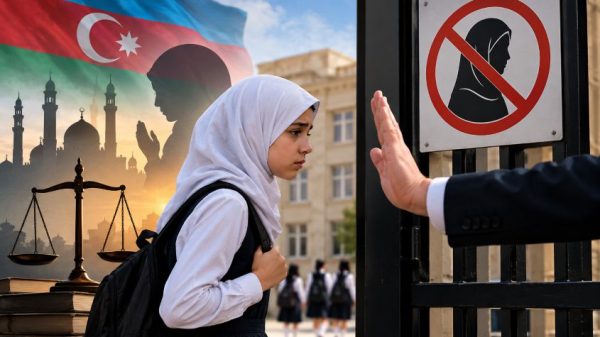
A controversy over the wearing of hijab in schools in Azerbaijan, a Muslim-majority country, has reignited a debate over religious freedom, the right to education and the limits of state secularism. Allegations that female students wearing hijab have been denied access to classrooms because of school dress codes have raised serious questions about whether restrictions imposed in the name of secular education can unjustifiably interfere with the religious rights of students.
Although the majority of Azerbaijan’s population is Muslim, the country follows a secular constitutional system. Its Constitution recognises both the separation of religion and the state and the freedom of religion. The controversy, however, centres on whether the enforcement of school uniform regulations adequately protects these constitutional principles.
An Alleged Obstacle to Religious Practice
In Islam, modesty and appropriate dress are important aspects of religious teaching. Many Muslim women and girls wear the hijab as an expression of their faith, personal conviction and religious identity. For them, it is not merely a piece of clothing but also a visible expression of their commitment to religious values.
When a student is prevented from attending school because she wears a hijab, a potential conflict arises between her freedom of religion and her right to education. If a girl wishes to continue her studies but faces restrictions because of her religious attire, it is reasonable to question whether such a policy is compatible with the principle of equal access to education.
However, the precise scope of the restrictions, the wording of the relevant government directives and the manner in which individual schools implement them must be carefully verified. It would be equally inappropriate to assume, without sufficient evidence, that every school in Azerbaijan has imposed an identical prohibition.
How Far Can Secularism Go?
One of the central purposes of a secular state is to ensure equal treatment regardless of religious belief and to protect the rights of all citizens. But does secularism necessarily require restrictions on the visible expression of religious identity? Answering this question requires a clear distinction between state neutrality and individual religious freedom.
A state may choose not to give official preference to any particular religion. That does not automatically mean that citizens should be prevented from practising their faith in their personal lives. When educational institutions impose dress codes, the rules should be assessed to determine whether they are lawful, necessary, proportionate and non-discriminatory.
There may be legitimate arguments in favour of a standard school uniform. However, if the purpose of a uniform policy is to maintain discipline and consistency rather than to prohibit religious expression, authorities should consider whether reasonable accommodation can be made for religious attire such as the hijab.
Should Access to Education Depend on Clothing?
Education is a fundamental right of every child. No student should be deprived of educational opportunities because of her religious identity or beliefs. If girls are denied entry to classrooms because they wear hijab, the consequences may extend beyond religious freedom to affect their education, psychological well-being and future prospects.
The government therefore has a responsibility to ensure that the enforcement of dress codes does not unnecessarily exclude students from education. At the same time, compelling a girl either to wear or to remove the hijab would also raise questions about personal autonomy. Decisions should respect students’ rights, their safety, their age and the applicable law.
Why Is This Controversial in a Muslim-Majority Country?
Although most Azerbaijanis are Muslim, the country operates under a secular constitutional framework. A population’s religious identity and the legal character of its state are not the same thing. Nevertheless, restrictions on religious attire in a Muslim-majority society can understandably provoke public debate and concern.
If the government invokes secularism to justify its policies, it must ensure that the rules are applied consistently, transparently and equally. An impartial review is also necessary to determine whether students from a particular religious group are being placed at a disadvantage.
Dialogue, Not Exclusion, Is the Way Forward
The controversy over hijab should not be resolved solely through prohibitions or protests. Constructive dialogue among the government, school authorities, parents, students, religious representatives and human rights organisations is essential.
Authorities should explore whether school discipline and uniform requirements can be maintained without unnecessarily restricting religious freedom. Students who believe they have been denied education because of their religious attire should also have access to transparent complaint procedures, impartial reviews and effective remedies.
The controversy over hijab in Azerbaijani schools raises a fundamental question: Is it justifiable to restrict an individual’s religious freedom in the name of state secularism?
Secularism and religious freedom need not be opposing principles. A just state should seek to balance both, ensuring that no student is denied education or equal opportunities because of her religious beliefs.
Protecting religious freedom does not mean compelling anyone to practise a religion. It means allowing individuals to live according to their beliefs within the limits of the law. If students are denied access to education because they wear hijab, the justification, necessity and non-discriminatory nature of such restrictions must be subjected to rigorous scrutiny.