

What Rights Does a Citizen Have at the Time of Arrest?
- আপডেট টাইম : শুক্রবার, ২৮ আগস্ট, ২০২৬
Human Rights Desk
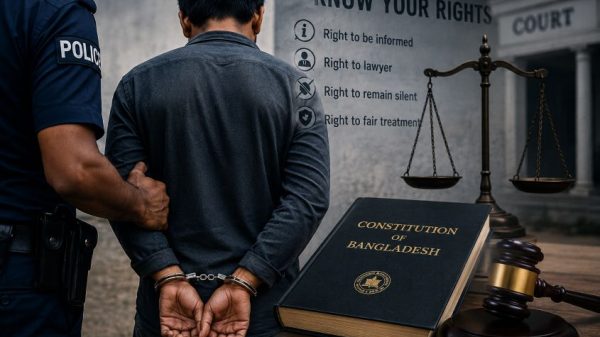
An arrest is one of the most serious forms of state intervention in an individual’s personal liberty. Law enforcement agencies may arrest a person when the law permits it, but an arrest does not mean that a citizen loses all of their rights.
In Bangladesh, the Constitution and criminal laws provide several safeguards for people who are arrested or detained. These protections are intended to ensure that law enforcement authorities exercise their powers within the boundaries of law and that an accused person is treated with dignity and fairness.
As Bangladesh enters 2026, understanding these rights has become increasingly important for ordinary citizens.
The Right to Know Why You Are Being Arrested
One of the most important protections is the right to know the reason for an arrest.
Article 33 of the Constitution of Bangladesh provides that a person who is arrested must be informed, as soon as possible, of the grounds of the arrest. The Code of Criminal Procedure also contains provisions concerning arrests without a warrant and the requirement to communicate the grounds for arrest.
Following recent legal reforms, the requirement to inform an arrested person of the reason for the arrest has received greater emphasis.
Therefore, when a person is arrested, they may calmly ask the authorities why they are being arrested, under which case or allegation, and under what legal authority.
The Right to Consult a Lawyer
An arrested person has the right to consult and be defended by a legal practitioner of their choice, subject to the applicable legal procedures.
This protection is particularly important because a person who has been arrested may not fully understand the legal consequences of the situation. A lawyer can explain the allegations, advise the person about the legal process and represent their interests before the court.
Family members should therefore try to contact a lawyer as soon as possible after learning about an arrest.
The 24-Hour Rule
Another important safeguard concerns the length of police custody.
Under Section 61 of the Code of Criminal Procedure, a person arrested without a warrant generally cannot be detained by police for more than 24 hours without a special order from a magistrate. The time necessary to travel from the place of arrest to the magistrate is excluded from this period.
If the investigation cannot be completed within 24 hours and further detention is considered necessary, the arrested person must be produced before a magistrate. The magistrate then decides whether further custody is legally justified.
This rule is intended to prevent people from being kept in police custody indefinitely without judicial oversight.
Arrest Does Not Mean Guilt
Perhaps one of the most important principles in criminal justice is that an accused person is not automatically a criminal.
An arrest means that authorities suspect a person of involvement in an alleged offence. It does not mean that the allegation has already been proved.
A person is entitled to a fair legal process, and guilt must ultimately be determined through the judicial system.
This distinction is also important for journalists. News reports should generally describe someone as an “accused person” or “suspect” rather than declaring the person guilty before a court has reached a final decision.
Protection Against Illegal or Arbitrary Arrest
Police have legal powers to arrest people without a warrant in certain circumstances. However, those powers are not unlimited.
Section 54 of the Code of Criminal Procedure sets out circumstances in which police may arrest a person without a warrant. Recent legal reforms have also introduced changes concerning the exercise and accountability of arrest powers.
The central principle remains that an arrest should have a lawful basis.
If someone believes that they have been unlawfully or arbitrarily arrested, they may seek legal remedies through the courts.
Protection Against Torture and Ill-Treatment
Being in police custody does not remove a person’s right to humane treatment.
The Constitution of Bangladesh provides important protections relating to personal liberty, criminal justice and treatment of accused persons. Torture, cruel treatment or degrading treatment is inconsistent with these fundamental protections.
If an arrested person becomes sick or is injured while in custody, the need for medical attention should be properly addressed.
Families should also document relevant information, including the time and place of arrest, the police station involved, the case number and any visible injuries, where possible.
The Importance of Informing Family Members
For families, an arrest can be frightening and confusing. In many situations, relatives may initially have difficulty finding out where the arrested person has been taken or what case has been filed against them.
Once a family learns about an arrest, it is important to establish:
- Where the person has been taken;
- Which police station is handling the matter;
- The case number, if available;
- The legal provisions under which the person has been accused;
- When the person is expected to be produced before a court; and
- Which lawyer will represent the person.
Keeping these details can make it easier to obtain legal assistance and follow the judicial process.
What About Bail?
Arrest does not necessarily mean that a person must remain in custody until the end of a criminal case.
Whether an accused person can obtain bail depends on several factors, including the nature of the alleged offence and whether the offence is classified as bailable or non-bailable under applicable law.
Section 496 of the Code of Criminal Procedure contains provisions concerning bail in bailable offences. For non-bailable offences, bail may depend on the circumstances of the case and the discretion of the competent court under the law.
For this reason, families should obtain a copy of the case details and seek advice from a qualified lawyer as soon as possible.
What Should a Citizen Do During an Arrest?
If a person is being arrested, remaining calm is extremely important.
Rather than physically resisting the arrest, the person should try to understand the legal basis for the arrest and ask for the reason clearly. If possible, they should contact a lawyer or ask family members to arrange legal assistance.
A person should also be cautious before signing documents that they do not understand. If there is uncertainty about a document, seeking legal advice is advisable.
Where circumstances permit, important details such as the time and location of arrest, the identity of the arresting officers, the police station and the relevant case information should be recorded.
A Matter of Human Rights
The power to arrest is an important tool for maintaining law and order, but that power must always be exercised according to law.
A person may be arrested on suspicion of committing an offence, but the arrest itself should not become a licence for humiliation, torture, unlawful detention or denial of legal protection.
The fundamental principle is simple: law enforcement and human rights should work together, not against each other.
For citizens, knowing their rights can help them respond more responsibly and effectively during an arrest. For law enforcement agencies, respecting those rights strengthens public trust and the rule of law.
As Bangladesh moves through 2026, ensuring lawful arrests, judicial oversight, access to legal representation and humane treatment remains an important part of protecting human dignity and strengthening the justice system.
Legal Disclaimer: This article is intended for general public awareness and does not constitute legal advice. Specific arrest, detention or criminal cases should be addressed with the assistance of a qualified lawyer.